Solutions
Solutions by Customer
Support
SUPPORT
Join
Property settlement scam awareness, behaviours and attitudes in Australia, 2026
Report
Scams Settlement Index

Property settlement scam awareness, behaviours and attitudes in Australia, 2026

In colloboration with Nature Research • Aug 2026 • 5 mins


Foreword from The Hon Anoulack Chanthivong, New South Wales Minister for Better Regulation and Fair Trading

The Hon Anoulack Chanthivong

The Hon Anoulack Chanthivong

Minister for Better Regulation and Fair Trading, Minister for Industry and Trade, Minister for Innovation, Science and Technology, Minister for Building Minister for Correction

For many Australians, buying a home is one of the biggest purchases they’ll make, representing years of hard work, sacrifice and planning. It should be one of life’s most rewarding milestones. Yet for a growing number of people, buying a home is becoming a time of heightened vulnerability to increasingly sophisticated scams and an opportunity for scammers to target life’s biggest financial transaction.

The findings in this report show that the threat of property settlement scams is not only real but evolving. While awareness of scams has increased, confidence in identifying them is declining. At the same time, new technologies like artificial intelligence are enabling criminals to create increasingly convincing scams that can catch even the most vigilant consumers off guard.

Behind every scam statistic is a real person, whether a first-home buyer who’s spent years saving for a deposit, a family planning their next chapter, or a retiree looking to invest and secure their future. The financial loss can be devastating, but the emotional toll, stress, and loss of confidence can be just as significant.

Addressing this challenge requires a shared commitment. Governments, regulators and industry must continue working together to strengthen safeguards, improve awareness and build trust in the systems that support property transactions.

Awareness remains one of our strongest defenses. The simple message: Stop, Check, Protect, urges consumers to take the time to verify information and question unexpected requests, as it can make all the difference.

I commend PEXA for its leadership in highlighting the risks of property settlement scams and for contributing valuable insights that support evidence-based action. Together, we can strengthen consumer confidence, reduce the harm caused by scams and ensure Australians can pursue the dream of home ownership with greater security and peace of mind.


Overview

How prepared are Australians to avoid property fund transfer scams?

For most Australians, buying a property is the biggest transaction they’ll ever make.

The movement of large amounts of money makes buyers an attractive target for sophisticated scammers attempting to take advantage of a stressful, complex and unfamiliar process.

For Scam Awareness Week 2026, PEXA commissioned research to understand property fund transfer scam awareness and behaviour among those who have bought or intend to buy property. Our research looked at:

  • how confident people feel spotting scams
  • what they’d do if targeted.

Building on our 2025 research, this year’s study reveals how attitudes and behaviours are changing over time.


Highlights

Four key findings from this research

#1

Australian homebuyers are less confident about spotting scams

Compared with last year, Australian property buyers overall confidence that they can identify a scam has dropped from 51% in 2025 to 41% in 2026. It’s a sign of greater recognition of how sophisticated and convincing today's scams can be.

2025
0%
Confidence
2026
0%
Confidence
#2

As scam awareness grows, human verification matters more than ever

Checking in with a real, known person – whether face to face or over the phone – remains the top choice for avoiding scams and safely sharing sensitive information, with those intending to buy most likely to seek

0%
66% of Australians would meet in person before sharing their bank account details
#3

Australians are more alert, but still struggle to spot scams

Although Australians are increasingly seeking human verification during property transactions, many remain susceptible to scams. A third would still transfer funds after receiving a scam email, and four in ten failed to identify any scam markers, even after being told the email was fraudulent.

0%
38% of buyers would transfer funds after receiving a scam email
#4

Buying a property is considered one of life's most stressful events

Almost nine in ten Australians consider buying a property one of life’s most stressful events, alongside moving cities or countries and getting divorced. Greater sophistication in property scams is adding further pressure to an already stressful experience.

About 9 out of every 10 of Australians think buying a property is stressful
ATTITUDES TO SCAMS

Scam type awareness

Most Australians are aware of at least one type of scam, with phishing scams still the most familiar, followed by fake sale/rental listings and property investment scams.

0%
are aware of at least one scam type No change from 2025 (91%)
Click a series to isolate it, or hover a scam type to compare years.
0% 25% 50% 75% 100%

AI Voice Cloning is a new category added in 2026 (N/A = not asked in 2025).

ATTITUDES TO SCAMS

Confidence in identifying scams

Buyers are feeling less confident about spotting property scams, highlighting growing concern about how sophisticated scams have become.

Where scam identification confidence has decreased most

0%
Confident or very confident identifying a property scam
2025 0%
2026 0%
Select a cohort above to compare its 2025 and 2026 result.
Confidence in identifying a property scam
0% 10% 20% 30% 40%
ATTITUDES TO SCAMS

Confidence by scam type

While those who recently bought property feel more confident than those intending to buy, overall confidence in spotting property scams remains low across all scam types. 

How confident Australians are in spotting different property scam types

0% 10% 20% 30% 40% 50%
ATTITUDES TO SCAMS

AI voice cloning concern

Awareness of voice cloning scams is relatively high, with six in ten Australians aware of these types of scams. Those intending to purchase in the next 12 months are especially concerned about their potential impact.

0% are aware of AI voice cloning scams

How concerned are Australians about AI voice cloning scams?

Select a cohort to isolate it, or hover a concern level to compare buyers and intenders.

0% 10% 20% 30% 40%

Who’s most concerned about voice cloning scams?

Intenders — concerned or higher
Over 55 years old 0%
Under 55 years old 0%
ATTITUDES TO SCAMS

Life events & stress

Buying a property is considered by most to be one of life’s most stressful experiences – more stressful than moving cities or countries, or getting a divorce.

Stressful life events experienced by Australians

100%
80%
60%
40%
20%
0%
SCAM IDENTIFICATION

Can Australians spot a scam?

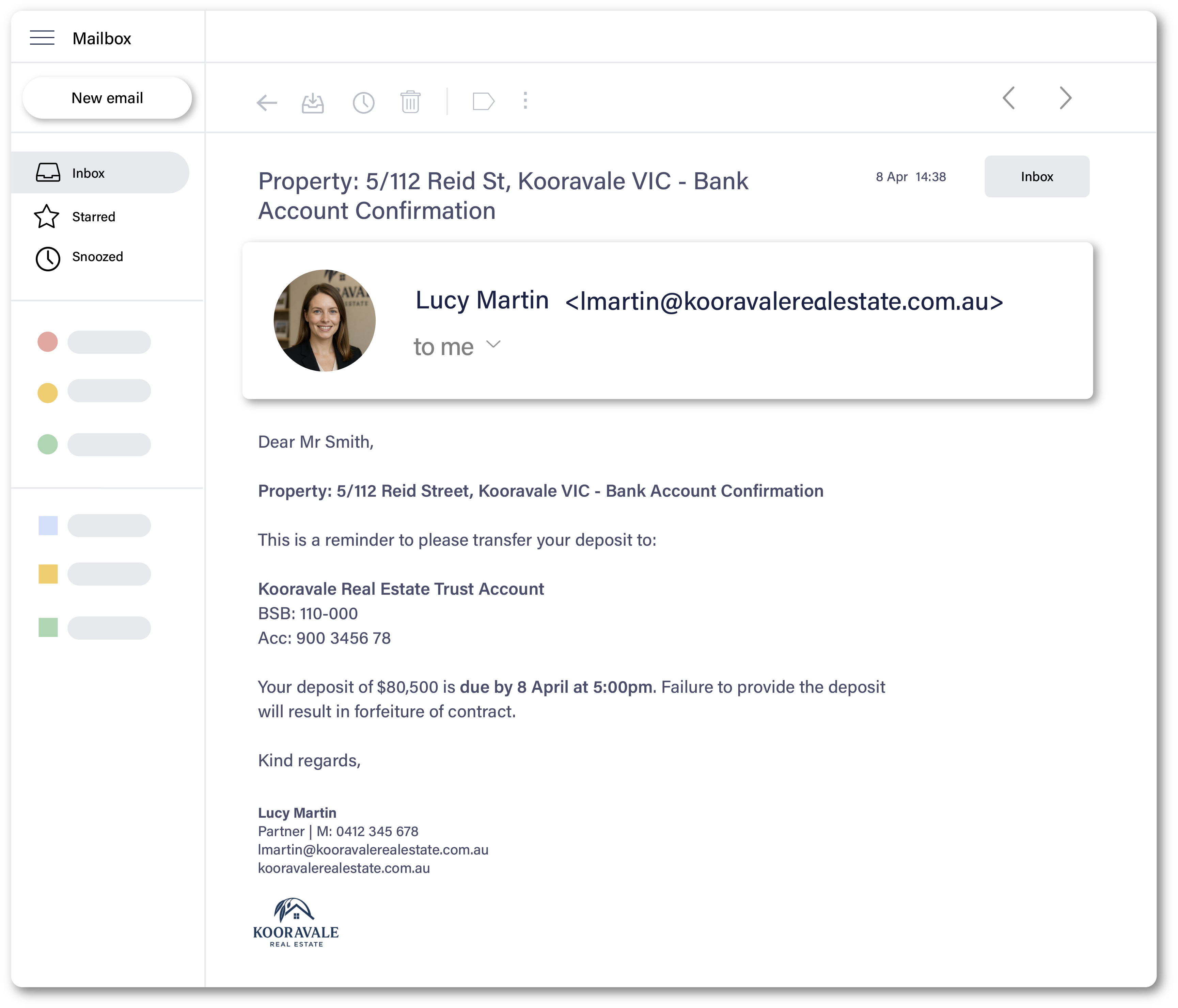
A mock scam email highlighted gaps in scam detection for over a third of those surveyed.

When shown this scam email asking for funds to be transferred to a scammer’s account, a third of buyers and potential buyers said they would transfer the funds requested – potentially falling victim to fraud.

For those who wouldn’t transfer the funds immediately, most still didn’t spot the scam – they were simply relying on human verification. 

Can Australians spot a scam?

How would Australians handle a convincing scam email?

Select a response

Each square is one per cent of the cohort. Buyers have bought in the last two years; intenders plan to buy.

Buyers
0%
Intenders
0%

Reasons for not transferring funds

Select a series to isolate it. Hover a reason to see the change since 2025.

Main scam email warning signs identified

SCAM IDENTIFICATION

Spotting scam red flags

Subtle scam markers proved to be too difficult for most Australians to pick up.

When told there were two issues with the scam email example, less than 1% could spot both, with nearly half admitting they were unable to see any issues at all.

The two telltale signs the email was a scam were the urgency of the request – a common tactic that uses fear to drive action before a victim can realise their mistake – and a false letter ‘a’ in the email address.

About half of all respondents believed they had spotted ‘other’ scam markers, demonstrating potential gaps in understanding of scam tactics and highlighting just how difficult it can be to spot a scam.

Scam markers spotted

Select a year to isolate it, or hover a marker to compare years.
SCAM BEHAVIOURS & ACTIONS

How Aussies share sensitive information

Australians prefer meeting in person first before sharing sensitive information like bank details with a real estate agent or conveyancer, highlighting the growing importance of human checks in scam prevention.

Nearly half of buyers would trust a secure digital platform such as PEXA Key, while 16% are willing to share sensitive details through less secure channels like email or messaging apps.

How Australians would share their bank account details during a property transfer

0%20%40%60%80%
SCAM BEHAVIOURS & ACTIONS

Secure tool usage among property buyers

While most recent property buyers (59%) were offered a secure tool such as PEXA Key to share payment or settlement information during their property purchase, a quarter chose not to use it.

Only 43% of Australian buyers overall showed interest in using a secure encrypted platform to share sensitive information. When offered a tool during their purchase, 74% of buyers did choose to use it, showing that familiarity and trusted recommendations increase confidence in sharing sensitive information securely.

Select a year to isolate it, or hover a group to compare years.

SCAM BEHAVIOURS & ACTIONS

How buyers verify sensitive information

Checking with a human and using secure, encrypted tools like PEXA Key are the top ways that recent property buyers verified sensitive data like bank account details during a property transaction.

0%
In 2026, only 2% of property buyers didn't verify the bank account details they were given
0%
33% of buyers used a secure app or tool like PEXA Key
0%
54% called the conveyancer or agent on a known phone number

Verification methods used, 2025 vs 2026

Select a series to isolate it, or hover a row to compare the two years.

0 20% 40% 60%
−6 −2 pts 0 +2 pts +6
SCAM BEHAVIOURS & ACTIONS

AI voice cloning scam avoidance

When presented with an AI voice cloning scam scenario, most Australians believe that making a phone call to a known or trusted number is the best action to take.

Most Australians are wary of accepting calls from unknown numbers and are aware of the correct ‘process’ for transferring money during a property sale, which is shown by two thirds of respondents calling the agent back on a verified number to confirm before making the transfer.

After getting a phone call from an unrecognised number and speaking to a voice they recognise as their agent, 5% of people think it’s ok to transfer the funds requested.

How Australians would respond to a suspicious payment request made by an agent via voice call

Sort to rank the responses, or hover a row to read it against the scale.

BACKGROUND & METHODOLOGY

Why and how we conducted this research

Ahead of Scams Awareness Week 2026, PEXA sought insights into Australians’ awareness of property fund transfer scams. This research builds on findings from our 2025 study, allowing us to track how attitudes and behaviours have changed.

Key topics for 2026

  • How people respond to common scam scenarios
  • Awareness of different scam types and confidence in spotting them
  • Scam behaviours, including sharing and verifying sensitive information, and actions they’d take in the event of a scam
  • Awareness and concerns around AI voice cloning scams

Who we surveyed

Methodology

What

7 minute online quantitative survey

When

Fieldwork was conducted in July 2026

Who

The 2026 study includes responses from n=1,028 Australian property buyers (last 12 months, n=500) or intending buyers (next 12 months, n=528). All respondents must be either a main or joint decision maker regarding the property purchase or the funds for the purchase. The data is nationally representative for age / gender / location and has been post weighted to reflect L12M buyer / N12M intender incidence in the population.

SCAM SMART QUIZ

Think you could identify a scam?

Take our quiz now to learn your scam smart score and brush up your scam safety.

Be The First To Know

Subscribe to receive the latest Property Insights, News & Events straight to your inbox. 

Australia Map

In the spirit of reconciliation PEXA acknowledges the Traditional Custodians of country throughout Australia and their connections to land, sea and community. We pay our respect to their Elders past and present and extend that respect to all Aboriginal and Torres Strait Islander people today.

© Property Exchange Australia Ltd. ABN 92 140 677 792.
We use cookies to improve your experience. You consent to the use of our cookies if you proceed. Visit our Privacy policy for more information.